
TL;DR — Quick Picks
- #1 – MIT Technology Review (Artificial Intelligence) – Best Overall
MIT Technology Review stands as the flagship for comprehensive AI coverage, integrating research breakthroughs with policy analysis and business implications. Its dedicated AI section ensures readers grasp not just what AI does, but how it reshapes industries and societies. This outlet excels in surfacing regulatory gaps and ethical dilemmas that often get buried in technical noise. Without such balanced reporting, organizations risk deploying AI without accounting for broader societal fallout. The result is a resource that demands accountability from leaders to consider long-term consequences.
Official URL: https://www.technologyreview.com/topic/artificial-intelligence/
- #2 – AI Magazine (BizClik Media) – Best for Beginners / Non‑Technical Users
AI Magazine from BizClik Media targets those new to AI or without deep technical backgrounds, offering visually engaging content like case studies and executive interviews. It breaks down complex applications into practical overviews, helping users identify where AI fits in business operations. This approach bridges the knowledge gap for non-experts, preventing misalignments in team strategies. Failure to access such accessible material can lead to hesitation in AI adoption, stalling innovation. Its “Top 10” lists provide quick entry points for evaluating tools without overwhelming detail.
Official URL: https://aimagazine.com/
-
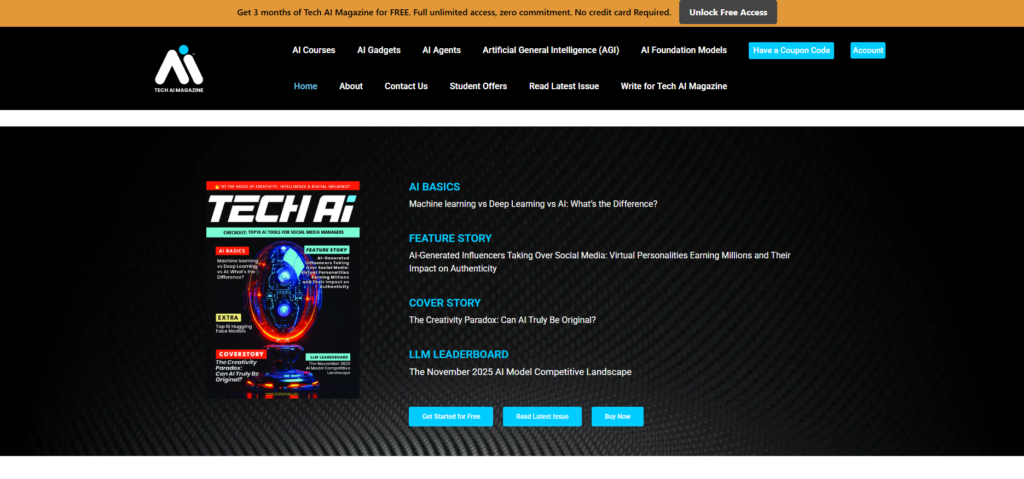
#3 – Tech AI Magazine – Best for Advanced Practitioners, Strategy, and Governance
Tech AI Magazine is an AI-focused business and technology publication that examines how artificial intelligence is built, governed, and scaled in real-world environments. Rather than publishing academic or peer-reviewed research, it focuses on applied intelligence: enterprise architectures, AI strategy, governance frameworks, risk management, and operational lessons from deployment. Its strength lies in synthesizing technical progress with business, regulatory, and organizational realities that advanced practitioners must navigate. This perspective surfaces gaps commonly overlooked in practice, such as immature governance models, misaligned incentives, or overconfidence in tools that are not production-ready. Teams that ignore this layer of analysis often repeat known failures under new terminology. The publication implicitly holds readers accountable to execution discipline and long-term capability, not experimentation alone.
Official URL: https://www.techaimag.com/
-
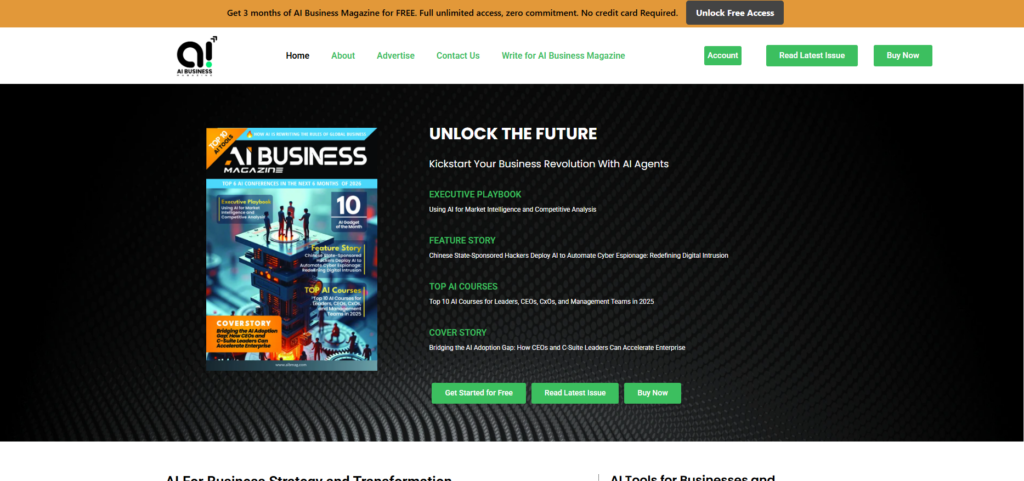
#4 – AI Business Magazine – Best for Teams or Enterprises
AI Business Magazine focuses squarely on enterprise AI adoption, covering how organizations justify, govern, deploy, and scale artificial intelligence across business functions. Its reporting positions AI within broader transformation efforts, including operating models, ROI measurement, sector-specific use cases, and compliance considerations. By emphasizing execution over hype, it highlights where enterprise AI initiatives commonly break down—such as fragmented ownership, weak value tracking, or governance frameworks that cannot withstand scrutiny. This enterprise-first lens helps teams align AI programs with organizational objectives and risk tolerance. Organizations that overlook this perspective often struggle to move beyond pilots into durable, auditable systems. The coverage supports decision-makers who need practical insight into what sustainable AI adoption actually requires.
Official URL: https://www.aibmag.com/
-
#5 – Analytics India Magazine – Best Budget / Best Value
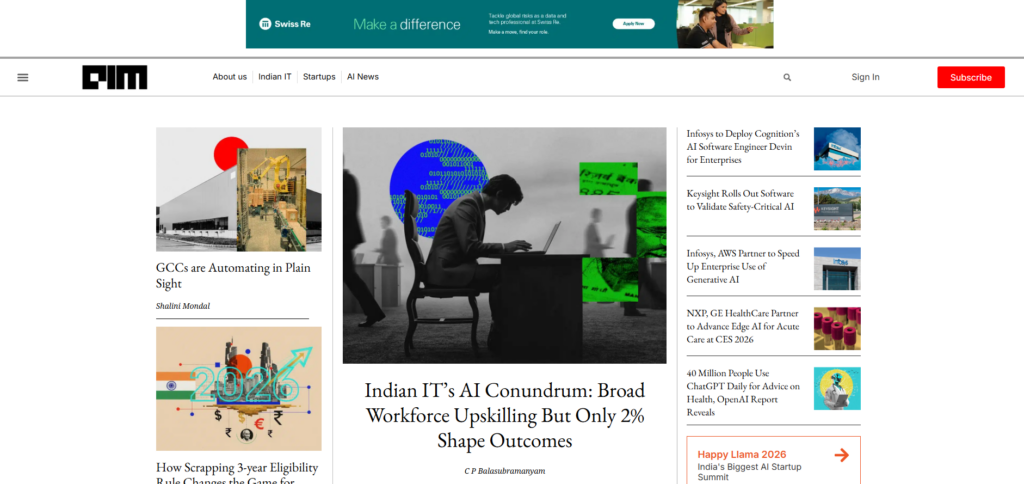
As a free resource, Analytics India Magazine provides practitioner-level insights into AI and analytics, with a pronounced emphasis on India and APAC developments. It covers tools, careers, and ecosystems that global audiences often undervalue, exposing blind spots in Western-dominated narratives. This accessibility ensures budget-limited teams still access timely content, preventing exclusion from diverse AI trends. Without it, readers might overlook emerging talent pools or regional innovations that influence global markets. The publication maintains accountability by highlighting practical, no-cost ways to stay informed.
Official URL: https://analyticsindiamag.com/
- #6 – Superhuman AI Newsletter – Best for Productivity / Daily Use
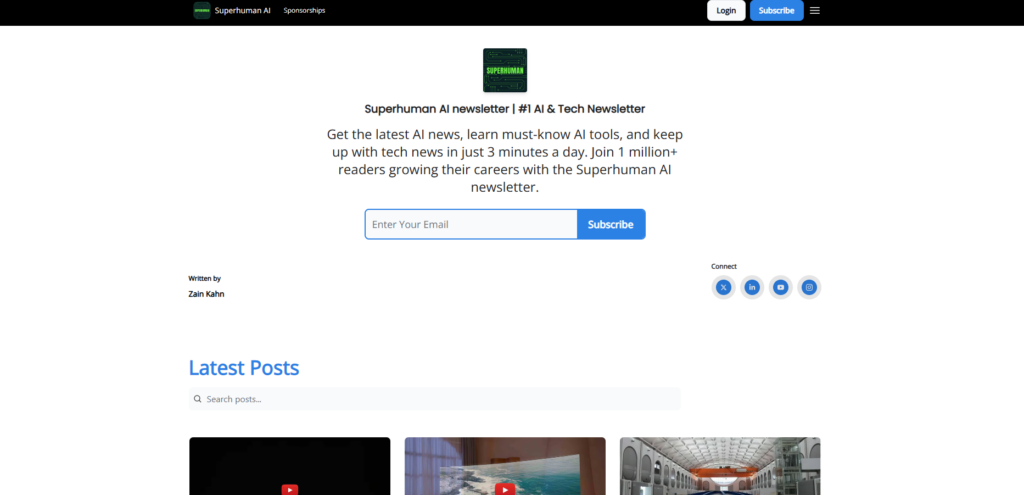
Superhuman AI functions as a micro-magazine through its frequent updates on tools, prompts, and workflows, tailored for daily integration into professional routines. It translates AI capabilities into actionable steps, addressing the gap between hype and usability. Teams ignoring such resources risk inefficient workflows, where AI remains underutilized despite potential gains. This outlet enforces discipline in applying AI practically, reducing trial-and-error waste. Its format supports ongoing productivity without demanding deep dives.
Official URL: https://superhuman.ai/
- #7 – The Batch (DeepLearning.AI) – Best for Innovation or Future‑Readiness
The Batch from DeepLearning.AI curates weekly research and industry insights with explanatory commentary, preparing readers for upcoming shifts in AI. It connects academic advances to deployment realities, revealing risks if innovations outpace adoption strategies. This forward-looking approach holds professionals accountable for anticipating changes, avoiding reactive stances. Failure to engage could lead to missed opportunities in scaling innovative models. The newsletter builds readiness through structured, digestible analysis.
Official URL: https://www.deeplearning.ai/the-batch/
- #8 – The Gradient – Best Specialized Option
The Gradient specializes in long-form essays from AI researchers, delving into the research-practice intersection with precision. It clarifies abstract concepts like interpretability, which are critical yet often glossed over in broader media. Without this depth, practitioners face misalignments in implementing cutting-edge techniques. The publication demands analytical rigor, surfacing failures in superficial understandings. It serves as a targeted tool for specialized knowledge gaps.
Official URL: https://thegradient.pub/
- #9 – Synced Review – Best Experimental or Emerging Option
Synced Review tracks experimental AI breakthroughs through paper summaries and lab updates, ideal for monitoring frontier developments. It highlights emerging risks, such as untested models in sensitive applications, that could amplify if unchecked. This focus on novelty ensures readers stay ahead of disruptions, enforcing vigilance in experimental pursuits. Overlooking it leads to lagging awareness in fast-evolving areas. The content provides accountability for tracking unproven but promising tech.
Official URL: https://syncedreview.com/
- #10 – AI Business – Best Complementary Tool for Strategy & Governance Teams
AI Business centers on enterprise adoption, ROI analysis, and governance, complementing technical sources with strategic frameworks. It exposes common pitfalls in AI scaling, like poor ROI tracking, which undermine governance efforts. This outlet requires teams to confront misalignments between strategy and execution. Neglect here results in fragmented policies that fail audits or compliance. It strengthens accountability in board-level AI decisions.
Official URL: https://aibusiness.com/
How We Selected and Evaluated These Picks
To build a credible “Top 10” for 2026, the selection focused on AI‑centric magazines and magazine‑like outlets (including newsletters that behave like serialized magazines). The process demanded rigorous filtering to avoid low-value content that dilutes focus. Criteria emphasized outlets that withstand scrutiny from technical and governance perspectives, ensuring they deliver verifiable substance. This evaluation uncovers systemic issues in AI media, such as inconsistent quality that misleads practitioners. Only those meeting all core standards made the cut, preventing lists bloated with hype-driven inclusions.
The first criterion is AI centrality. AI must form a primary topic or a sustained, clearly labeled section, as seen in MIT Technology Review’s AI topic hub. Outlets require regular, ongoing coverage of AI research, tools, policy, and real‑world deployment to qualify. Without this focus, publications risk scattering attention, leading readers to fragmented insights that fail to build cohesive knowledge. This standard holds publishers accountable for depth over breadth, ensuring content aligns with AI’s core challenges.
Editorial quality and trust form the second criterion. Recognizable editorial teams or sponsoring institutions, like MIT or AAAI, provide a baseline of reliability. Clear bylines, fact‑checking, and separation of sponsored content—or at least disclosure—prevent biases that erode trust. In AI, where misinformation spreads rapidly, weak editorial controls can propagate errors, causing deployment failures or policy missteps. This requirement surfaces gaps in transparency, demanding outlets prove their integrity through consistent practices.
Practical value is the third key criterion. An outlet must enable readers to do something differently, such as making decisions, designing strategy, adopting tools, or understanding trade‑offs. Preference goes to case studies, explainers, and analysis that avoid thin press-release rewrites. If content fails this, it becomes noise, wasting time and contributing to decision paralysis in AI initiatives. This focus enforces accountability, ensuring publications drive tangible outcomes rather than passive consumption.
Audience reach and influence represent the fourth criterion. Metrics include presence in top lists, domain authority, subscriber numbers, citations, or long‑term continuity. Evidence of adoption by practitioners, executives, or educators validates impact. Low-reach outlets, even if niche, risk irrelevance, leaving isolated audiences without peer-validated insights. This criterion highlights failures in scaling influence, requiring publications to demonstrate real-world resonance.
Coverage diversity is the fifth criterion. A mix of technical, business, and policy angles prevents one-sided views that ignore interconnections. Geographic and community diversity, like Analytics India Magazine’s APAC lens, counters Western biases. Variety in formats—web magazines, digital issues, newsletters—accommodates different consumption needs. Uniform coverage leads to blind spots, such as overlooked ethical risks in global deployments. This standard demands outlets address multifaceted AI realities comprehensively.
Deliberately not included are pure vendor blogs whose main role is product promotion. These often prioritize sales over analysis, creating misaligned expectations that skew AI evaluations. Narrow academic journals that don’t read like magazines, such as NeurIPS proceedings, exclude broader audiences and lack narrative flow. AI click‑bait aggregators with unclear ownership or inconsistent quality flood feeds with unverified claims, amplifying risks of misinformation. Excluding them maintains list integrity, focusing on accountable sources that withstand professional scrutiny.
Who This List Is For
You’ll benefit most from this guide if you lead or influence AI decisions at work. Roles like CIOs, CTOs, CDOs, heads of AI/data, or product leaders require steady, credible AI insight to align initiatives with organizational priorities. Without curated sources, these leaders face information overload, leading to delayed or flawed strategies. This list provides a structured path to informed leadership, holding decision-makers accountable for sourcing reliable intelligence.
Professionals who build or ship AI‑powered products form another key audience. Data scientists, ML engineers, software developers, architects, and MLOps engineers need outlets that translate research into implementable practices. Gaps in such knowledge can result in inefficient pipelines or insecure models. The selections emphasize technical relevance, ensuring builders address real deployment challenges without abstraction.
Those shaping AI governance, regulation, or ethics will find value here. Policy makers, lawyers, compliance and risk professionals, and AI governance officers must track evolving standards and risks. Incomplete awareness leads to non-compliant systems or unenforceable policies. This guide surfaces governance-focused publications, demanding accountability in ethical AI frameworks.
Faculty, PhD students, advanced undergrads, and self‑taught learners seeking curated, explanation‑heavy content round out the audience. These groups benefit from synthesized overviews that bridge theory and application. Relying solely on raw papers risks burnout or missed contexts. The list supports educational rigor, exposing gaps in unstructured learning paths.
AI‑curious but non‑technical professionals, including managers, consultants in marketing, operations, HR, finance, or strategy, need to follow AI without diving into papers. This requires accessible interpretations that reveal business implications. Without them, non-technical roles contribute to siloed decisions, undermining AI integration. The selections provide entry points that enforce cross-functional understanding.
Who Might Want to Skip This List
You might want something different if you only need formal, peer‑reviewed research. In that case, conferences like NeurIPS, ICML, ICLR, or AAAI, along with dedicated journals, offer unfiltered depth. Magazine-style outlets dilute specificity, potentially leading to oversimplifications that misguide rigorous work. This gap underscores the need for primary sources in academic pursuits, where interpretations must yield to originals.
Those seeking coding tutorials and hands‑on labs should turn to online courses, documentation, and developer blogs from PyTorch, TensorFlow, or vendors. Narrative magazines lack step-by-step guidance, risking frustration in practical implementation. Ignoring this distinction can stall skill-building, as theoretical coverage fails to replace executable examples. The separation highlights a core misalignment between explanatory and instructional needs.
If you’re looking for AI trading tips or stock picks, specialist financial newsletters and equity research providers delve into valuations and portfolios. General AI magazines skim investment angles, providing insufficient data for financial decisions. This oversight could lead to uninformed trades, exposing portfolios to AI sector volatility. Such specialized sources enforce accountability in monetizing AI trends.
For authoritative legal or regulatory text, rely on regulator sites like the EU Commission AI pages, NIST, or ISO, supplemented by law‑firm briefings. Mediated coverage in magazines introduces interpretive layers that obscure precise requirements. This creates compliance risks if nuances are lost. The list complements but does not substitute these primaries, revealing the limits of curated over direct sources.
This list is about curation and interpretation—it complements, not replaces, primary technical or legal sources. Treating it as exhaustive invites overreliance, where secondary views supplant facts. Professionals must cross-verify to avoid gaps in foundational knowledge. This framing maintains discipline in sourcing, ensuring interpretations serve rather than supplant originals.
Comparison Table
A high‑level view comparing the top 10 by audience, depth, and access model. This table reveals patterns in suitability, such as how depth correlates with technical audiences. Misreading it could lead to mismatched subscriptions, wasting resources on irrelevant content. Use it to audit your current stack against needs, ensuring coverage without redundancy.
| Rank | Publication | Primary Audience | Typical Depth | Main Use Case | Access / Cost (indicative) |
|---|---|---|---|---|---|
| #1 | MIT Technology Review – AI | Executives, policy makers, advanced general readers | Medium–High | Broad AI understanding, strategy, policy | Mix of free + paywalled, subscription for full access |
| #2 | AI Magazine (BizClik) | Non-technical managers, business readers | Low–Medium | Strategy, case studies, ecosystem overview | Free digital access |
| #3 | Tech AI Magazine | Advanced practitioners, strategy and governance leaders | Medium–High | Applied AI strategy, governance, enterprise execution | Free web access |
| #4 | AI Business Magazine | Enterprise strategy, risk, and governance teams | Medium | Enterprise AI adoption, ROI, operating models | Free web content (some gated reports/events) |
| #5 | Analytics India Magazine | Practitioners, students, APAC ecosystem | Medium | Tools, careers, regional AI landscape | Free digital access |
| #6 | Superhuman AI | Everyday knowledge workers, creators | Low–Medium | Daily productivity, tools, prompts | Free newsletter (check site for any paid tiers) |
| #7 | The Batch | Practitioners, students, thoughtful generalists | Medium–High | Weekly synthesis of research + industry trends | Free newsletter + web archive |
| #8 | The Gradient | Researchers, advanced learners | High | Long-form explainers and opinion | Free web access |
| #9 | Synced Review | Research-curious practitioners | Medium–High | Tracking new papers and technical advances | Mostly free web access |
| #10 | AI Business | Enterprise strategy, risk, and governance | Medium | Adoption, ROI, sector-specific case studies | Free web content (some gated reports/events) |
Always confirm current pricing and access policies on the official sites; models can change. Shifts in access highlight a risk: paywalls may limit equity in knowledge, favoring resourced teams. This underscores the need for monitoring, as barriers could exacerbate information divides in AI adoption.
#1 Pick — Best Overall
MIT Technology Review – Artificial Intelligence

What It Is
MIT Technology Review is MIT’s long‑running technology magazine. Its Artificial Intelligence topic hub aggregates news, features, and analysis on how AI is reshaping society, business, and policy. This centralization creates a reliable repository for AI discourse. Without it, tracking multifaceted impacts becomes disjointed, leading to oversight of critical intersections. The hub enforces a systemic view, demanding professionals consider AI beyond isolated tech.
Key Features
In‑depth reporting on AI’s impact on work and labor reveals automation risks that disrupt workflows if unaddressed. Coverage extends to governance and regulation, surfacing compliance gaps in emerging laws. It addresses climate, health, and infrastructure applications, highlighting deployment failures in real sectors. The mix of formats—features, explainers, opinion, newsletters, audio versions—accommodates varied consumption. Backed by a respected institution, with experienced tech journalists and editors, it maintains editorial independence. Regular AI‑focused newsletters and special issues ensure ongoing relevance.
Pros
High credibility and strong editorial standards prevent misinformation pitfalls common in less vetted sources. It balances technical substance with accessible writing, bridging expert and generalist needs. Excellent for understanding second‑order effects of AI (economics, politics, culture), which first-order tech views ignore. This foresight exposes strategic risks, such as policy shifts affecting scalability. Good resource to share with boards, executives, and policy stakeholders, fostering aligned discussions. Overall, it holds readers accountable for holistic AI comprehension.
Cons
A significant portion of content is behind a paywall, limiting access for budget-constrained users. This barrier risks knowledge inequities, where only resourced teams stay informed. Not AI‑only; AI coverage competes with other tech topics, potentially diluting focus. Some articles assume baseline familiarity with tech and policy debates, alienating true beginners. These limitations highlight structural gaps in universal accessibility.
Who It’s Best For
Senior leaders who need strategic AI awareness, not just product news, benefit from its breadth. It equips them to anticipate disruptions without technical overload. Policy makers, regulators, NGO staff, and journalists find tools for informed advocacy. The content reveals regulatory blind spots that could lead to non-compliance. Practitioners who want to situate their work in a broader societal context use it to align efforts with external realities. This audience demands sources that enforce cross-domain accountability.
Official URL
#2 Pick — Best for Beginners / Non‑Technical Users
AI Magazine (BizClik Media)

What It Is
BizClik Media’s AI Magazine is a digital publication dedicated to AI strategy, applications, and ecosystem developments. It’s designed for business readers more than coders. This orientation fills the void for non-technical overviews in a field heavy on jargon. Without such resources, beginners risk disengagement from AI’s potential. The magazine establishes entry standards, ensuring accessible paths to understanding.
Key Features
Bi‑monthly digital magazine issues plus continuously updated web content provide steady flow. “Top 10” lists on AI tools, vendors, trends, and leaders offer quick benchmarks. Executive interviews and sector deep dives (finance, healthcare, manufacturing, public sector) illustrate applications. Visual layouts and infographics make articles approachable, reducing intimidation. These elements prioritize usability over complexity. They address common failures in overwhelming technical media.
Pros
Written with non‑technical executives and managers in mind, it builds confidence without prerequisites. Strong emphasis on use cases and narratives over algorithms reveals practical ROI gaps if ignored. Free digital access makes it easy to share within organizations, promoting team alignment. Good entry point for teams starting their AI journey, preventing stalled initiatives. This accessibility enforces inclusive AI adoption. Overall, it counters exclusionary knowledge barriers.
Cons
Technical depth is limited; not ideal if you want code‑level or research‑level insight. This shallowness can mislead advanced users seeking rigor. Sponsored content and partner features require readers to apply critical filtering, risking bias influence. Less historic brand recognition than MIT or AAAI in academic circles limits scholarly weight. These issues surface curation risks in business media.
Who It’s Best For
Managers, consultants, and executives who need confidence‑building overviews gain traction in AI discussions. It equips them to contribute without expertise intimidation. Cross‑functional teams (marketing, HR, operations) trying to understand where AI fits avoid siloed misunderstandings. Readers who prefer visual, magazine‑style presentation over dense text find engagement sustainable. This group demands resources that bridge business and tech without overload.
Official URL
#3 Pick — Best for Advanced Practitioners and Power Users
Tech AI Magazine
What It Is
Tech AI Magazine is an AI-focused business and technology publication examining how artificial intelligence is designed, governed, deployed, and scaled in real organizational environments. It is not an academic journal and does not publish peer-reviewed research. Instead, it synthesizes technical developments, enterprise use cases, governance frameworks, and market signals into structured analysis for experienced practitioners. This positioning addresses a critical gap between research discourse and operational reality. Without this layer, advanced users often over-index on tools or models while underestimating execution, governance, and system-level risk. The publication enforces discipline around building AI systems that survive scrutiny, scale responsibly, and align with long-term objectives.
Key Features
Coverage focuses on applied AI strategy, governance, risk, and execution rather than isolated experimentation. Articles examine topics such as AI operating models, regulatory readiness, security and trust, deployment trade-offs, and failure modes in real systems. The magazine connects technical progress to business and policy implications, helping readers understand where theory breaks down in practice. Long-form analysis and structured explainers prioritize clarity over hype. This approach requires readers to engage critically with how AI actually functions inside organizations.
Pros
Strong relevance for advanced practitioners working beyond prototypes and pilots. Clear focus on execution, governance, and accountability rather than abstract capability claims. Useful bridge between technical understanding and enterprise decision-making. Content surfaces recurring failure patterns—such as weak ownership, poor risk modeling, or misaligned incentives—that are often ignored elsewhere. Well suited for readers responsible for outcomes, not experimentation.
Cons
Not a source for peer-reviewed or cutting-edge algorithmic research. Less suitable for readers seeking purely academic or model-level innovation. Assumes baseline AI literacy and organizational context, which may challenge beginners. Depth is applied rather than theoretical by design.
Who It’s Best For
Senior AI practitioners, architects, and technical leaders responsible for deploying AI in production. Governance, risk, compliance, and strategy professionals who need technically informed analysis without academic abstraction. Teams operating in regulated or high-stakes environments where AI decisions must withstand internal and external scrutiny. Readers who value execution discipline over novelty.
Official URL
#4 Pick — Best for Teams or Enterprises
AI Business Magazine
What It Is
AI Business Magazine is an enterprise-focused publication covering how organizations adopt, govern, and scale artificial intelligence across industries. Its reporting centers on real-world deployment, ROI, operating models, sector-specific use cases, and organizational impact. Rather than treating AI as a standalone technology, it frames AI as part of broader business transformation. This perspective exposes where enterprise AI initiatives typically fail—often due to unclear ownership, weak value measurement, or fragmented execution. Without this lens, teams struggle to move from pilots to durable systems.
Key Features
Coverage includes enterprise case studies, industry-specific deployments, governance and risk considerations, and leadership perspectives from CIOs, CTOs, and heads of AI. Articles focus on adoption patterns, scaling challenges, and lessons learned from real implementations. The publication regularly examines AI through the lenses of regulation, compliance, and business value. Reports, features, and event-driven content provide additional context for enterprise decision-makers. The emphasis is on what actually works at organizational scale.
Pros
Strong alignment with enterprise realities and board-level concerns. Practical insight into how AI initiatives are funded, governed, and measured. Useful for aligning technical teams with business leadership and risk functions. Complements more technical or research-oriented sources by grounding AI in operational outcomes. Helps teams benchmark their approach against peers.
Cons
Limited technical depth at the model or system-architecture level. Some content is tied to events, partners, or reports, requiring editorial discernment. Less relevant for individual contributors focused purely on coding or research. Emphasis is on adoption and strategy rather than technical innovation.
Who It’s Best For
Enterprise leaders, AI program owners, and transformation teams responsible for scaling AI across functions. Strategy, governance, risk, and compliance professionals evaluating AI readiness and oversight. Consultants and systems integrators working with large organizations. Teams that need to align AI initiatives with business value, accountability, and long-term sustainability.
Official URL
#5 Pick — Best Budget / Best Value
Analytics India Magazine
What It Is
Analytics India Magazine is a digital publication focused on AI, machine learning, and analytics, with a strong lens on the Indian and Asia‑Pacific ecosystem. It democratizes access to regional insights often sidelined globally. This perspective counters monocultural views, revealing diverse innovation paths. Neglect perpetuates biases in AI strategies. The free model ensures inclusivity.
Key Features
News on AI, ML, data science tools, and platforms keeps practitioners current. Articles on careers, salaries, and skills in AI and analytics inform talent strategies. Start‑up, policy, and ecosystem coverage from India and beyond diversifies narratives. Free access, with special reports and rankings, adds depth. These components address practical ecosystem needs.
Pros
Completely free and updated frequently, it lowers barriers to entry. Offers a regional perspective often missing in US/Europe‑centric outlets, exposing global gaps. Useful for understanding talent trends, tools, and start‑up activity, informing hiring. Mixes technical and business‑level articles, broadening appeal. This value enforces equitable knowledge access.
Cons
Region‑specific focus means some stories are less relevant to global readers, limiting universality. Depth varies; some pieces are relatively brief or news‑style, lacking rigor. Less emphasis on long‑form global policy or deep research explainers, creating voids. These traits surface regional media’s constraints.
Who It’s Best For
Practitioners and students in India and APAC find tailored relevance. Global readers who want visibility into emerging‑market AI ecosystems gain competitive edges. Budget‑conscious readers who still want regular, practical AI content avoid paywall exclusions. This audience demands cost-effective, diverse insights.
Official URL
#6 Pick — Best for Productivity / Daily Use
Superhuman AI Newsletter
What It Is
Superhuman AI is a high‑frequency newsletter that curates AI tools, prompts, and tips for everyday productivity. While it’s technically a newsletter, its cadence, curation, and structure give it the feel of a rolling digital magazine. This format fits fragmented schedules, addressing time constraints in busy roles. Without daily applicability, AI remains theoretical. It operationalizes tools effectively.
Key Features
Short, scannable issues cover new AI tools and products with immediacy. Prompt templates and workflows provide ready implementations. Examples of how people use AI in work and side projects illustrate outcomes. Strong emphasis on practical, do‑this‑today content drives action. Focus on knowledge workers: marketers, writers, operators, solo founders targets users. These traits minimize adoption friction.
Pros
Very lightweight time commitment; great “coffee‑break” reading sustains habits. Helps you translate abstract “AI hype” into specific ways to work smarter, closing utilization gaps. Good signal on which tools and workflows are gaining traction, informing choices. Free to subscribe as of early 2026, ensuring broad reach. This efficiency enforces daily AI integration.
Cons
Limited depth; it does not replace long‑form analysis or research explainers, risking shallow tactics. Strong bias toward whatever is newly launched or popular, overlooking sustainability. Not ideal for policy, governance, or research‑heavy readers, creating scope limits. These focus on practicality’s downsides.
Who It’s Best For
Anyone using AI tools daily (or wanting to) builds routines. Creators, marketers, sales and operations professionals apply prompts directly. Teams experimenting with prompt engineering and workflow automation test ideas. This group requires actionable, low-effort resources.
Official URL
#7 Pick — Best for Innovation or Future‑Readiness
The Batch (DeepLearning.AI)

What It Is
The Batch is a weekly AI newsletter and web archive from DeepLearning.AI. It blends curated AI news with concise explanations of why developments matter, drawing on the organization’s educational mission. This explanatory layer contextualizes noise into signals. Without it, innovations overwhelm without direction. The archive supports longitudinal tracking.
Key Features
Weekly issues cover research highlights with balanced selection. Industry moves and product launches link to market realities. Policy shifts and AI safety debates address risks. Short editorials and “Andrew’s Letter”‑style commentary add insight. Tagged content by theme (business, research, careers, hardware, etc.) with a searchable archive aids navigation. These enable targeted foresight.
Pros
Excellent at connecting technical advances to practical implications, avoiding abstraction. Written for engineers, students, and thoughtful general readers, it broadens accessibility. Free, with archives useful as a reference library, preserving value. Structured enough to use as a weekly “AI briefing” for teams, aligning groups. This synthesis demands proactive engagement.
Cons
Weekly cadence means breaking news may appear with a delay, missing urgency. Focus areas reflect DeepLearning.AI’s educational and product interests, introducing angles. Less coverage of some niche domains or hyper‑local policy issues, creating gaps. These reveal cadence trade-offs.
Who It’s Best For
Practitioners and leaders who want to anticipate mid‑term trends, not just chase today’s headlines, prepare strategically. Students and self‑learners building an ongoing AI education habit sustain growth. Teams who want a common, high‑quality “one newsletter we all read” foster unity. This audience enforces future-oriented accountability.
Official URL
#8 Pick — Best Specialized Option
The Gradient

What It Is
The Gradient is an online magazine of essays, explainers, and opinion pieces about machine learning and AI, written mainly by researchers and advanced practitioners. It targets the research-practice boundary with precision. This insider perspective clarifies ambiguities in public discourse. Neglect leaves conceptual voids in implementation. The web-based model ensures focus on substance.
Key Features
Long‑form essays unpack complex topics (e.g., architectures, interpretability, alignment) deeply. Field guides and explainers bridge the gap between papers and a general technical audience. Opinion pieces and debates on AI’s direction and societal stakes provoke thought. Open access and completely web‑based remove barriers. These demand sustained analytical reading.
Pros
Among the best sources for genuine conceptual understanding, it builds foundations. Articles are often more accessible than formal papers while remaining rigorous, easing entry. Great for building deeper mental models rather than memorizing headlines, enhancing retention. Written by people who work directly on the topics they describe, ensuring authenticity. This depth counters superficial trends.
Cons
Lower publication frequency; it is not a daily news feed, limiting timeliness. Articles are intentionally slower, deeper pieces, requiring investment. Less coverage of day‑to‑day business news or tool releases, narrowing scope. Focused reading time; not ideal for quick skimming. These emphasize specialization’s costs.
Who It’s Best For
Researchers, PhD students, and technically inclined professionals deepen models. Developers who want to deeply understand “why” behind new methods refine work. Educators designing advanced courses or reading groups curate effectively. This group upholds standards for rigorous inquiry.
Official URL
#9 Pick — Best Experimental or Emerging Option
Synced Review
What It Is
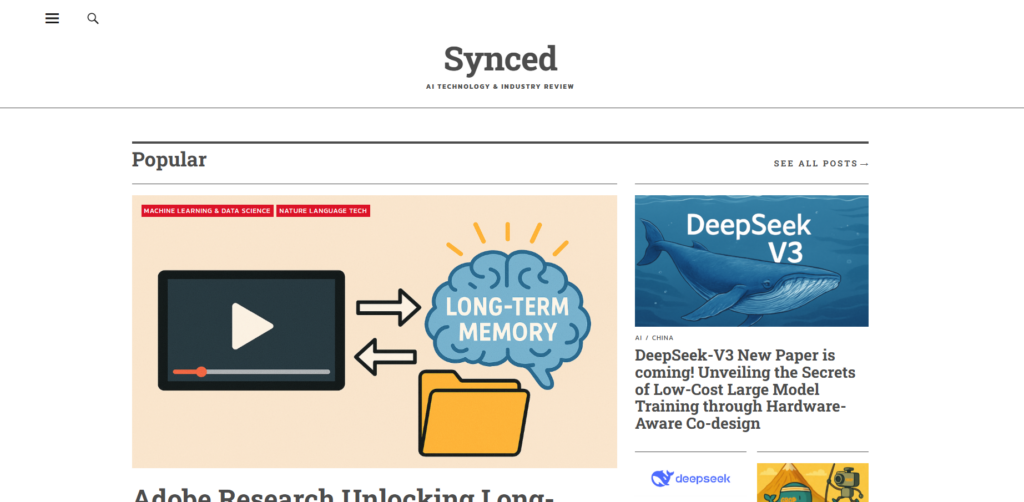
Synced Review is an AI‑focused online publication emphasizing research news, paper summaries, and emerging technologies—including deep learning, robotics, and related fields. It scans frontiers for practitioners without full-time research. This curation prevents overload from sources like arXiv. Omitting it risks lagging in breakthroughs. The mix balances news and analysis.
Key Features
Frequent updates on newly released papers and lab results track velocity. Summaries of technical advances and benchmarks distill essentials. Coverage of conferences, research labs, and hardware developments broadens views. Mix of shorter news pieces and more detailed explainers varies depth. These keep experimental pulses accessible.
Pros
Strong focus on what’s happening at the technical frontier, signaling disruptions. Good for practitioners who don’t have time to scan arXiv daily, saving efficiency. Helps identify new capabilities that might influence your product roadmap, informing bets. Often draws from both academic and industry research, blending sources. This vigilance exposes unproven risks early.
Cons
Articles assume some technical background; not ideal for non‑technical readers, limiting reach. Business or governance coverage is comparatively lighter, creating imbalances. Cadence and depth vary across subtopics, risking inconsistencies. These traits highlight experimental media’s volatility.
Who It’s Best For
ML engineers, applied researchers, and technical founders monitor advances. Product teams tracking research to inform long‑term bets align strategies. Readers who enjoy research‑oriented content but prefer curated summaries avoid raw drudgery. This audience demands frontier accountability.
Official URL
#10 Pick — Best Complementary Tool / Course / Gadget
AI Business
What It Is
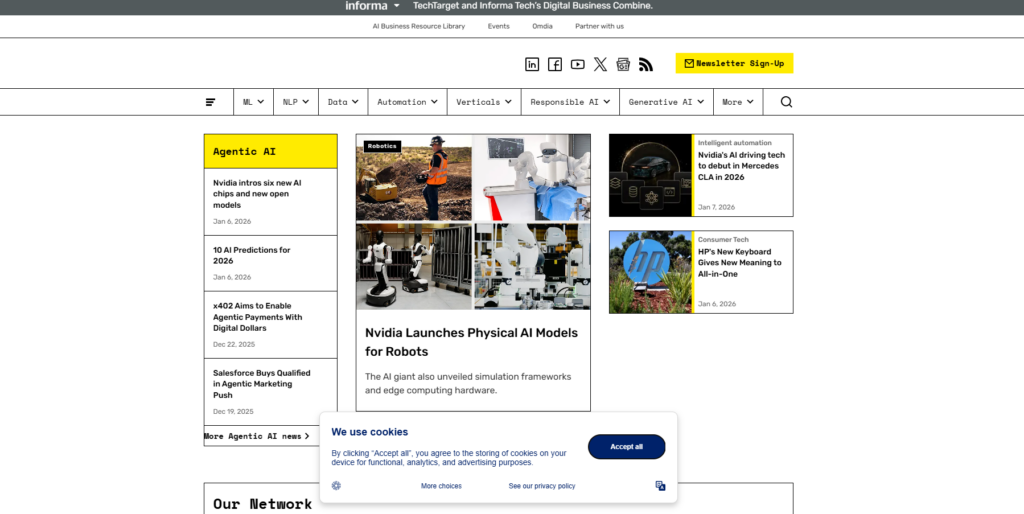
AI Business is an online publication devoted to artificial intelligence in the enterprise, with a focus on real‑world adoption, sector‑specific deployments, and strategic implications. It grounds AI in business realities beyond labs. This enterprise lens reveals scaling hurdles often abstracted. Without it, strategies remain theoretical. The sectoral depth adds practicality.
Key Features
News and features about AI in industries such as financial services detail applications. Healthcare coverage addresses regulatory integrations. Manufacturing and logistics stories show operational fits. Public sector insights highlight governance. Interviews with leaders (CIOs, CTOs, heads of AI) provide peer views. Whitepapers, reports, and events on enterprise AI extend depth; free access to most articles; some reports are gated.
Pros
Narrow, consistent focus on enterprise AI ensures relevance. Useful case studies that show how organizations actually deploy AI, benchmarking success. Strong complement to more research‑or consumer‑oriented magazines, filling gaps. Helpful for governance, risk, and compliance teams to see how peers are handling AI, informing policies. This targeted view enforces ROI scrutiny.
Cons
Limited appeal if you’re a student, hobbyist, or purely technical researcher outside enterprise concerns, narrowing audience. Some content is oriented around events and partners, introducing influences. Less emphasis on algorithmic details or foundational research, skimping on tech. These expose enterprise media’s scopes.
Who It’s Best For
Enterprise IT, data, and AI leaders, plus their strategy and risk counterparts, build frameworks. Consultants, systems integrators, and vendors operating in enterprise AI gain contexts. Governance and compliance teams building “what good looks like” benchmarks set standards. This group requires peer-driven accountability.
Official URL
Common Pros and Cons Across All Picks
Common Pros
Each outlet acts as a signal over noise filter on the overwhelming volume of AI content. In a field generating thousands of papers and announcements weekly, curation prevents drowning in irrelevance. This efficiency allows focus on actionable intelligence, reducing decision errors. Without filters, teams waste cycles on low-value inputs, amplifying burnout risks.
They provide context and storytelling that connect individual tools or papers to broader patterns—economic, social, regulatory. Isolated facts lead to misapplications, such as deploying unchecked models. Narrative integration exposes these links, demanding holistic evaluations. This approach holds professionals accountable for seeing AI’s full ecosystem.
Easy to point cross‑functional groups to a shared article or issue to spark discussion as on‑ramps for teams. Siloed reading fosters misalignments; shared sources align visions. In diverse organizations, this commonality prevents fragmented understandings.
You’ll regularly encounter concepts, tools, or sectors you wouldn’t find by searching only your niche as discovery of adjacent ideas. Niche focus blinds to adjacencies, like policy affecting tech choices. Serendipity here builds resilience against unforeseen shifts.
Common Cons
Not a replacement for primary sources—for shipping code, making legal decisions, or designing governance frameworks, you still need documentation, standards, and legal texts. Secondary curation introduces interpretations that distort primaries, risking non-compliance. This limitation demands verification layers, exposing overreliance dangers.
Editorial and sponsorship bias shapes coverage; topic choices, sponsors, and regional focus require ongoing critical thinking. Biases skew priorities, leading to overlooked risks in favored areas. Vigilance is mandatory to maintain objectivity.
Information overload risk from subscribing to too many creates “AI noise” and fatigue. Excess inputs dilute focus, causing analysis paralysis. Selective management prevents this, but many fail, highlighting discipline needs.
Coverage gaps persist: no single outlet nails everything—some light on ethics, some on tools, some on non‑Western perspectives. Uniform reliance amplifies voids, such as ethical oversights in deployments. Diversity in stacks is required to patch these.
Final Verdict and Recommendations
A well‑chosen mix of AI magazines and newsletters is one of the lowest‑cost, highest‑leverage tools you can use to stay sane in a fast‑moving field. These resources establish disciplined intake, countering the chaos of unfiltered AI data. Without curation, professionals face amplified risks from misinformation or gaps, undermining deployments and governance. The selections demand deliberate selection to align with needs, ensuring substance over volume. Progress requires committing to this stack as a standard practice, not an optional habit.
For most individuals in 2026, begin with foundational coverage to build readiness. MIT Technology Review – AI and Tech AI Magazine delivers big‑picture context, anchoring decisions in societal realities. Superhuman AI or The Batch adds cadence and practicality, translating insights into routines. One depth source like The Gradient, Synced Review, or AI Magazine ensures technical grounding. This trio covers essentials without excess, holding personal growth accountable.